tracking code

Showing posts with label Bread. Show all posts

Sunday, December 12, 2010

PANETTONE


Panettone is a fruity Italian loaf often eaten at Christmas time. I especially love Panettone toasted, and it makes the best French toast I've ever eaten! (French toast with Italian bread, made by a Kiwi in Japan - how's that for fusion cuisine?!) I make this recipe in my bread-maker, and it turns out very well.

3/4 cup warm water
6 tablespoons oil
1 and 1/2 teaspoons salt
4 tablespoons sugar
2 eggs
3 cups bread flour
1 packet dried yeast
1/2 teaspoon almond essence
1/4 chopped almonds (or walnuts)
1/4 raisins
1/4 lemon and orange candied peel
(you can add glace cherries and angelica too if you like)
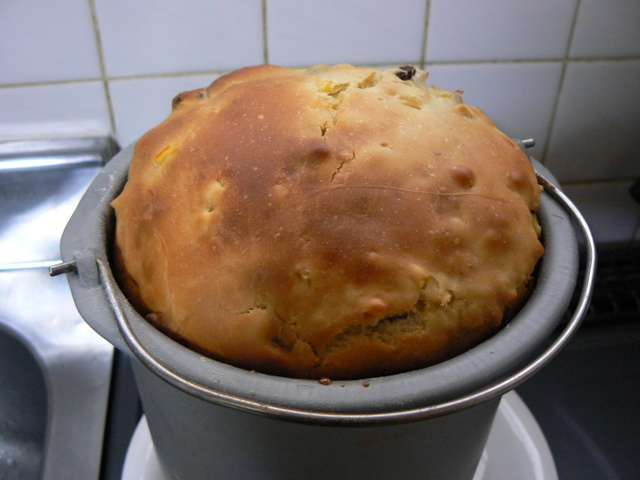
Put everything in the bread-making machine and run the light crust setting.
(Of course you could make this by hand if you don't have a bread-making machine.
Just follow the instructions for any sweet bread recipe.)

Tuesday, October 19, 2010

KIMCHI CHEESE BREAD

Gimchi, a very common side dish in KoreaImage via WikipediaKimchi is a Korean food - pickled Asian cabbage (or sometimes other vegetables) flavored with chili and garlic. Koreans seem to eat it with almost every meal. I first encountered it back home in New Zealand when we had Korean home-stay students staying with us. I tried to make home-made kimchi, and while the result was fairly tasty, the smell was absolutely terrible every time I opened the refrigerator.

I sometimes buy kimchi in Japan. I love kimchi fried rice, and kimchi-cheese takoyaki (octopus dumplings) are the most delicious takoyaki I've ever had. Kimchi name is also very good. But recently I decided to experiment with  kimchi-cheese bread (using my bread-maker of course.)

I made a basic white bread dough, then when the breadmaker finished the second kneading cycle, removed the dough, and quickly rolled it out. Then I generously sprinkled it with grated cheese, and dotted it with kimchi (warmed in the microwave so that it wouldn't slow the final rising of the bread.) Finally I rolled it up again and pushed it back into my bread-maker to rise and bake.

It was delicious! Definitely a winner! I put the kimchi a little too thickly in some places, so the filling fell out when I sliced the bread. Next time I will roll the dough more thinly and spread slightly less kimchi.

Enhanced by Zemanta

Sunday, August 22, 2010

THINGS ON TOAST

I have a breadmaker and bake my own whole-grain bread. It makes wonderful toast. Tomatoes on toast has been one of my favorite things since I was a child. I would slather on delicious New Zealand butter thickly, top with sliced tomato, and sprinkle liberally with salt and pepper. Since I came to Japan however, I've pretty much given up on butter. Hokkaido butter is pretty good, but it's also pretty expensive. Besides, I've lost the illusion of invincibility that is a part of being young, so using butter the way I like to use it (thickly) makes me feel vaguely guilty. And perhaps most significant of all, Japanese refrigerators don't seem to have butter conditioners. But I've found a very satisfactory substitute - mayonnaise.

I hate the too-sweet, too-acidic 'mayonnaise' in New Zealand. I never used it. You can buy wonderful mayonnaise in Japan, rich and creamy. Add crushed garlic and it would do for aoli (don't tell my friend Sandra, who is a real foodie, I said that!) I usually buy 'karashi' (hot muststard) flavor. It's an excellent stand-in for butter with tomatoes (doesn't work well with marmalade.) It's also really good with ham on toast. I never ate ham on toast before a Japanese friend introduced me to it, but now I'm a big fan.

The other thing I really love to eat on toast is banana.  And that doesn't need butter, just a sprinkle of cinnamon.

Monday, August 9, 2010

RICE & OTHER GRAINS

In Japan I buy three different kinds of grains. Of course I buy rice. Brown rice is available, but I usually buy white rice because I find it more versatile. Japanese rice has short, rounded grains and is kind of sticky when cooked. I eat rice most days, sometime with every meal, although my breakfast is very un-Japanese (more about breakfast in another post.)

In addition to white rice I also buy 'mugi' which is barley. I get barley to mix with the rice to add fiber and vitamins. And I like the slightly nutty texture it gives the rice, without being too 'wholegrain'. Also, sometimes I add it to vegetable soups in cold weather. Vegetable soup with barley reminds me of my mother's vegetable soup back in NZ.


Finally I buy mixed grain. It includes barley, millet, corn, black sesame seeds, brown rice, and several other unidentified grains. It's a bit expensive, and health conscious Japanese add it sparingly to rice, but I buy it for bread. I've always preferred wholegrain bread, but the selection and pricing of wholegrain bread in Japan seems aimed at discouraging general consumption. It is only available from expensive little boutique bakeries.


Never mind! Have breadmaker, will improvise!


Here is my wholegrain bread recipe for a breadmaker. It makes very delicious bread, excellent for sandwiches or toast. It reminds me of Vogel's bread in New Zealand.

Wholegrain Bread:  makes about 1 kg loaf 
Ingredients:

1/2 cup water
5/8 cup milk (or milk and yoghurt mixed)
2 1/2 cups bread flour
1 cup cooked mixed grains
1 1/2 teaspoon salt
2-3 tablespoons sesame oil
3 tablespoon sugar
1 1/2 teaspoon yeast


Follow manufacturers directions (OR put everything in the machine and switch on. That's what I do!)